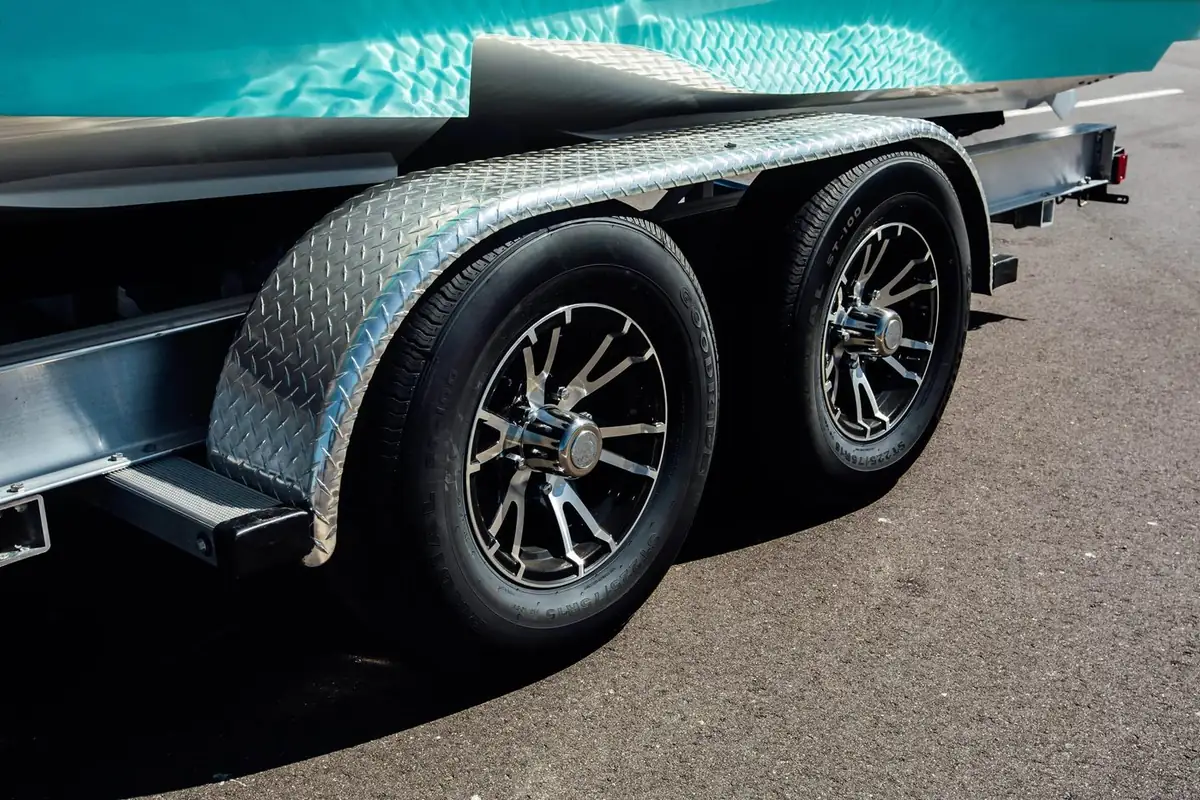
Almost every boat trailer that comes into our shop on US-27 on the back of a wrecker failed in one of three places: a hub, a brake, or a light. Not the frame. Not the winch. A hub, a brake, or a light — and every one of those failures had a warning sign somebody could have caught in a driveway with a flashlight and ten minutes.
In Florida, a boat trailer needs four rhythms: every launch, rinse it and put a hand on each hub. Every month, check tire pressure, lights, and the winch strap. Every six months, repack or inspect the bearings and pull a wheel to look at the brakes. Every year, flush the brake fluid, torque every U-bolt and fastener, and go over the bunks. The usual manufacturer interval for bearings is 12 months or 10,000 miles — in salt, we cut that to six months. Skip the rinse and repack and about 15 salt launches is all it takes to put a hub on borrowed time.
We build aluminum boat trailers and we repair every make there is, so we see the same trailer at both ends of its life. The maintenance below is what we’d do to our own rigs. It’s organized the way you’ll actually use it: by how often, then by the part.
The Florida boat trailer maintenance schedule
| How often | What | Why it matters here |
|---|---|---|
| Every launch | Fresh-water rinse (frame, hubs, brakes, springs, lights, underside). Hand on each hub before you dunk. | Salt plus heat is the whole problem. A hot hub backed into cool water pulls water past the seal. |
| Every trip | Coupler latched and pinned, safety chains crossed, lights working, strap and bow stop tight, tire pressure. | Cheap five-minute walk-around. Catches the failures that happen at 65 mph. |
| Monthly | Tire pressure to sidewall max cold, tread and sidewall cracks, lug torque, winch strap, breakaway cable. | ST tires lose pressure sitting in the sun. Cracked sidewalls fail with no warning. |
| Every 6 months | Bearing inspection or repack, pull a wheel and inspect brake pads or shoes, check brake lines, grease the coupler and jack. | Salt-launched hubs won’t wait a full year. Seized brakes are the most common thing we find. |
| Yearly | Flush brake fluid, torque every U-bolt, spring hanger and axle bolt, inspect bunks and bunk hardware, load-test lights and grounds, replace worn seals. | Brake fluid absorbs water. U-bolts and hangers sit low and rust quietly. |
| Every 5–6 years | Replace the tires regardless of tread. | Trailer tires age out before they wear out. |
Print that, tape it inside the garage door, and you’ve done more than most of the trailers we tow in. Now the details, part by part.
Every launch: the salt rinse and the hub check
The rinse is the cheapest repair you’ll never need. Two minutes with a hose at the ramp — or a wash-down at home within the hour — is the difference between a trailer that lasts and one that doesn’t. Get the underside, the springs and hangers, the inside of the wheels where the brake sits, and the light plugs. The top of the frame is the part that matters least.
The other habit is a hand on each hub before you back down the ramp. Warm is normal. Too hot to keep your hand on means a bearing is already going, and the last thing that hub needs is a dunk.
A hot hub in cool water is a pump. The air inside the hub contracts as it cools and draws water past the seal into the grease. Do that every weekend without repacking and the bearing runs in a salt-water emulsion until it lets go — usually on I-75 or SR-200, usually with a boat on top. If you've towed more than a half hour to the ramp, let the hubs cool 10–15 minutes before you launch. Rig the boat, load the cooler, then back in.
Bearings: the part that decides everything
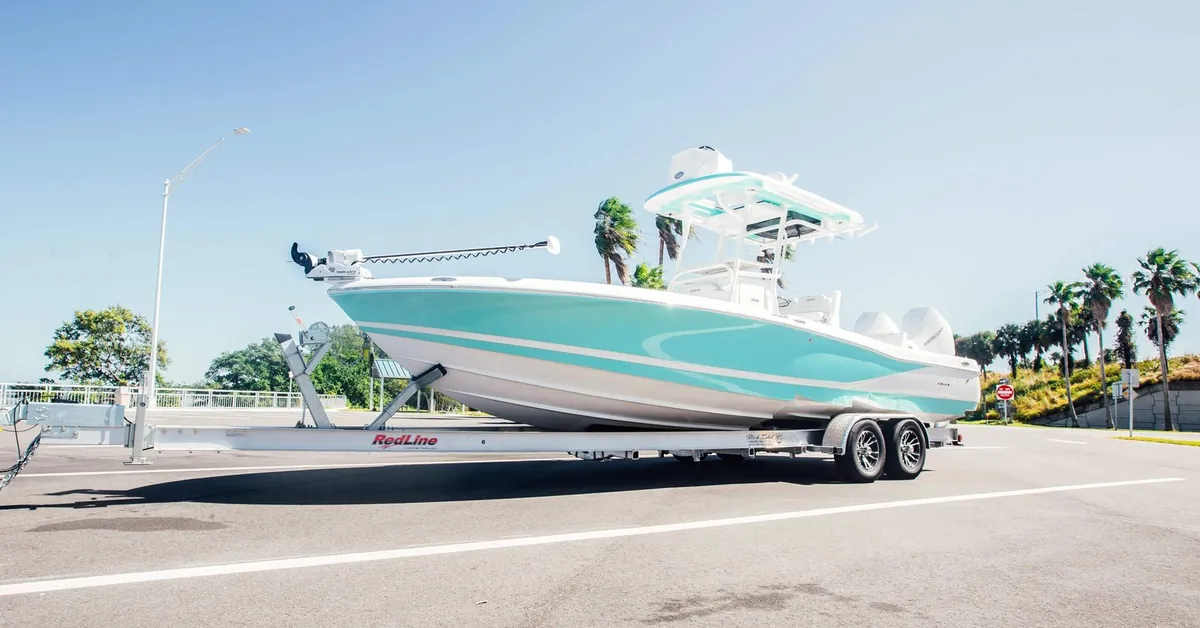
Bearings are the reason most boat trailers end up on the shoulder. They live inside a hub that gets heated on the highway, chilled in the water, and packed with salt on the way home.
- Repack or inspect every six months if you launch in salt. The usual manufacturer guidance is 12 months or 10,000 miles. Crystal River, Homosassa, Cedar Key and the Gulf ramps don't give you 12 months. Fresh-water-only trailers on Lake Weir or the Ocklawaha can run the full year.
- Pull the dust cap and look at the grease. Clean grease is tan or amber. Milky, gray or runny grease has water in it — the bearings need to come out, get cleaned and inspected, and go back with new seals, not just more grease pumped on top.
- Replace the seal every time you repack. A seal costs a few dollars. A seal that's been pried out and reused is the leak you're trying to prevent.
- Spin the wheel with it jacked up. Rough, notchy or noisy means the races are pitted. Replace the bearing and race as a set.
- Check for play. Grab the tire at 12 and 6 o'clock and rock it. Any movement means the castle nut is loose or the bearing is worn. Set the preload properly — snug, back off to the cotter pin slot, not cranked down.
- Don't rely on a bearing protector alone. Spring-loaded caps keep a little pressure on the grease and help, but they can also blow the rear seal if you overfill them. They're a supplement to repacking, not a replacement for it.
If you’d rather not do bearings on the driveway, that’s the most common thing we do. Our axle, bearing and brake service in Ocala covers repacks, new seals, hubs and full spindle replacement on any make of trailer, not just ours.
Brakes: the failure you don’t notice until you need them
Florida requires brakes on any trailer with a gross weight of 3,000 pounds or more, which is nearly every boat trailer with a real boat on it. Most of the ones we see have brakes that stopped working months before the owner knew.
- Pull a wheel every six months and look. Drum brakes fill with salt and seize. Disc calipers corrode and stick. Either way the pad wears on one side and the wheel drags — you'll feel it as a hub that runs hotter than the others.
- Flush the brake fluid yearly. DOT 3 and DOT 4 fluid absorb water from the air. Water in the line rusts the actuator from the inside and boils under hard braking. A yearly flush is cheap insurance; every two years is the absolute limit.
- Test the surge actuator. With the trailer hitched, push the coupler back by hand (or have someone brake gently while you watch). It should move smoothly and return. A sticky actuator means brakes that either drag or don't apply.
- Check the breakaway cable and, on electric-over-hydraulic, the breakaway battery. The cable should be attached to the tow vehicle, not the ball or the safety chains. The battery should hold a charge.
- Look at the lines. Steel brake lines rust through in salt. That's why every trailer we build uses non-corroding lines — and why a rusty line on an older trailer should be replaced, not patched.
Disc brakes beat drums in salt, every time. There's no drum to fill with sand and salt, the pads are visible without pulling anything apart, and they self-clean on the first stop. It's why disc brakes and a hydraulic actuator are standard on every RedLine trailer, and why an electric-over-hydraulic conversion is the single best upgrade we do on an older trailer that's going to live in the salt.
Tires: they age out before they wear out
Trailer tires are the one item on this list that fail while looking perfect. ST-rated tires are built for load, not mileage, and the rubber ages out in five to six years whether the tread is worn or not. Florida sun accelerates that.
- Read the DOT date code. The last four digits on the sidewall are the week and year of manufacture. Past five or six years, replace them — tread depth doesn't matter.
- Inflate to the max cold pressure on the sidewall. Trailer tires run at full pressure, not car pressure. Under-inflated is the number-one cause of trailer tire blowouts.
- Look for sidewall cracking — the fine checking that shows up on tires that sit in the sun. That's a tire that's done.
- Respect the speed rating. Most ST tires are rated for 65 mph unless marked otherwise. Running 80 on the turnpike with a boat behind you is how sidewalls let go.
- Re-torque the lug nuts after any wheel comes off — recheck at 50 miles — and check them monthly. Aluminum wheels loosen more than steel.
We fix the trailer, not the rubber. When yours need tires, we send people to trailer tires in Ocala at Tire Express, who stock real ST-rated tires and will read your date codes for free.
Lights and wiring: salt’s favorite target
Trailer wiring is a chain of crimps and grounds, and salt water attacks every one of them. A light that flickers is a light that’s about to fail, and a trailer with no brake lights on I-75 at dusk is a ticket at best.
- Check every light before every trip — running, brake, turn, both sides. Have someone stand behind you, or back up to a garage door.
- Unplug the connector at the ramp before you back in if you're still running incandescent bulbs. Hot bulbs crack in cold water. LEDs don't care, which is one more reason to convert.
- Clean the plug with contact cleaner and a dab of dielectric grease every few months. Corroded pins are the cause of half the "my lights are dead" calls we get.
- Chase the ground. Most trailer light problems are a bad ground, not a bad light. A ground screwed into a rusty frame is a ground that isn't.
- Seal the splices. Twist-and-tape splices don't survive Florida. Heat-shrink butt connectors do — it's the only way we wire a trailer, and a full re-wire with LEDs is one of the most common jobs in our shop.
Frame, suspension and hardware: the yearly go-over
Once a year, put the trailer on stands and go over everything that holds it together.
- Torque every U-bolt, spring hanger and axle bolt. They sit low, get dunked every trip, and fail quietly. On a leaf-spring trailer, a rusted U-bolt is an axle waiting to walk.
- Inspect the springs and shackles. Rust-thinned leaves and egg-shaped shackle holes both mean the suspension is on its way out. Torsion axles skip this whole item, which is why we build with them.
- Look at the welds and stress points. On aluminum: white powder at fasteners means galvanic corrosion; cracks at the tongue and axle mounts mean fatigue. On galvanized steel: rust bleeding from tube ends means the frame is rusting from the inside out. We covered both in detail in our [aluminum vs. galvanized steel boat trailer breakdown](/blog/aluminum-vs-galvanized-steel-boat-trailers/).
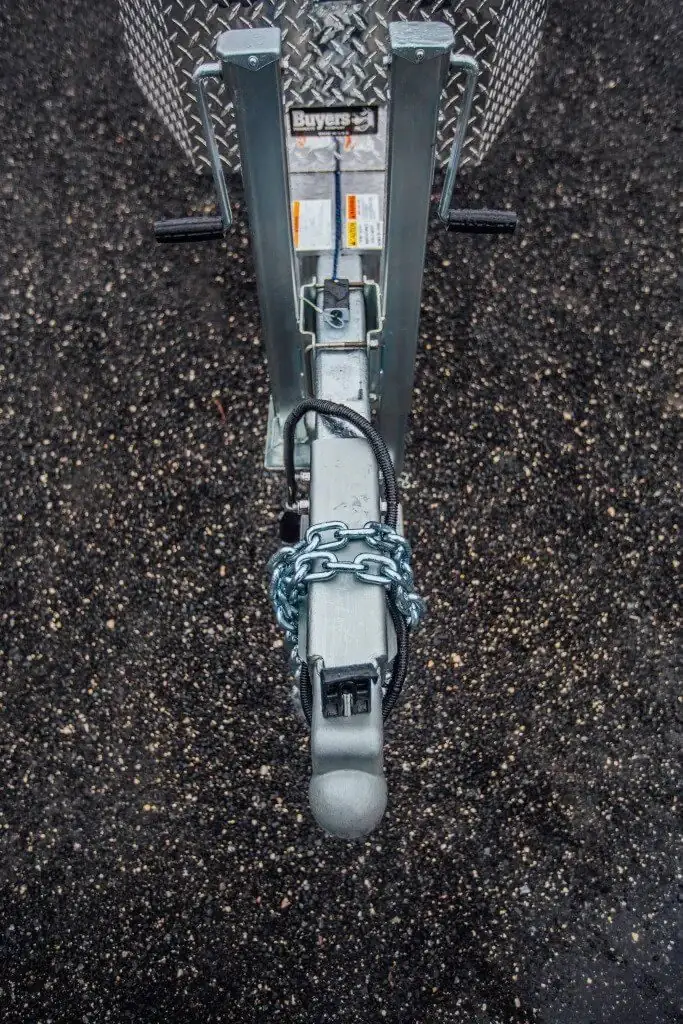
- Grease the coupler, the jack and the winch gears. A dry coupler wears the ball; a dry jack strips its gears the first time you crank it under load.
- Inspect the winch strap and the bow stop. Frayed, sun-faded strap edges are a strap that will let go under load. Replace it. Check the bow stop and the safety chain to the bow eye.
- Check the bunks and bunk hardware. Rotted boards, torn carpet, and rusted brackets all let the hull sit wrong. Cypress bunks with marine carpet last; pressure-treated pine with indoor carpet doesn't.
Do it yourself, or bring it in?
Do it yourself…
- The salt rinse, every single launch
- The pre-trip walk-around: lights, coupler, chains, strap, tires
- Tire pressure, date codes and lug torque
- Cleaning the light plug and greasing the coupler and jack
- Pulling a dust cap to look at the grease
Bring it to the shop…
- Bearing repacks if you'd rather not set preload by feel
- Anything with milky grease, play in the wheel, or a hub that runs hot
- Seized brakes, a sticky actuator, or a brake fluid flush
- A full re-wire, LED conversion, or a ground you can't find
- Rusted U-bolts, cracked welds, or a spring that looks thin
None of this is complicated. It’s just consistent, and consistency is what most trailers never get. The trailers we tow in on a wrecker didn’t fail because their owners couldn’t do this list — they failed because nobody looked.
Get the trailer looked at
Bearings, brakes, wiring, suspension — any make, any model. We'll tell you straight what's fine, what's due, and what's about to strand you.
Boat trailer maintenance questions we get every week
How often should I repack boat trailer bearings in Florida?
Every six months if you launch in salt water, and at least once a year or every 10,000 miles on a fresh-water-only trailer. That’s the usual manufacturer interval; salt launching is why we cut it in half. Repack means removing the bearings, cleaning and inspecting them, and reinstalling with fresh grease and a new seal — not just adding grease through a bearing protector.
Do I really need to rinse my boat trailer after every launch?
Yes, and the underside matters more than the parts you can see. Rinse the frame, hubs, brakes, springs, hangers, lights and plug with fresh water after every salt launch, ideally within the hour. It’s the cheapest maintenance there is and it prevents the most expensive failures.
How do I know if my trailer bearings are going bad?
Milky, gray or runny grease under the dust cap, play when you rock the wheel at 12 and 6 o’clock, a rough or noisy spin with the wheel jacked up, or a hub that runs noticeably hotter than the others after towing. Any one of those means the bearings need to come out and be inspected. Noise is the last warning, not the first.
Does a boat trailer need brakes in Florida?
Florida requires brakes on any trailer with a gross weight of 3,000 pounds or more, which covers nearly every boat trailer carrying a real boat. If your trailer has brakes, they need to work — seized drums or stuck calipers are the most common thing we find when we pull a wheel.
How long do boat trailer tires last?
Five to six years, regardless of tread. ST trailer tires age out before they wear out, and Florida sun speeds that up. Read the DOT date code on the sidewall, inflate to the maximum cold pressure printed there, and replace them on age. Most ST tires are rated for 65 mph unless marked otherwise.
Should I let my trailer hubs cool before launching?
Yes. After a highway tow, give the hubs 10–15 minutes at the ramp before backing in. A hot hub that hits cool water contracts and draws water past the seal into the grease, which is how most bearings fail. Use the time to rig the boat and load the cooler.
← All posts