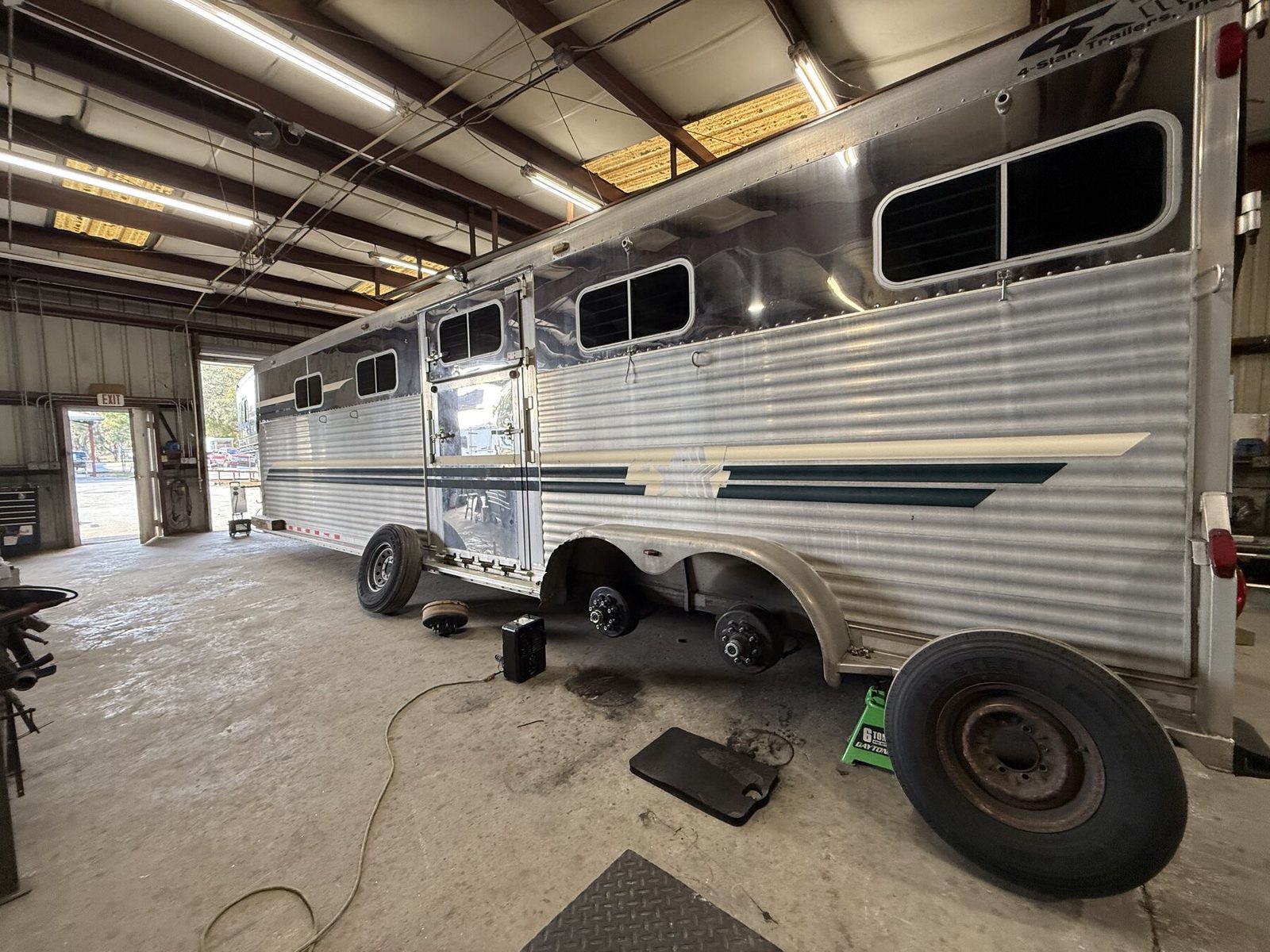
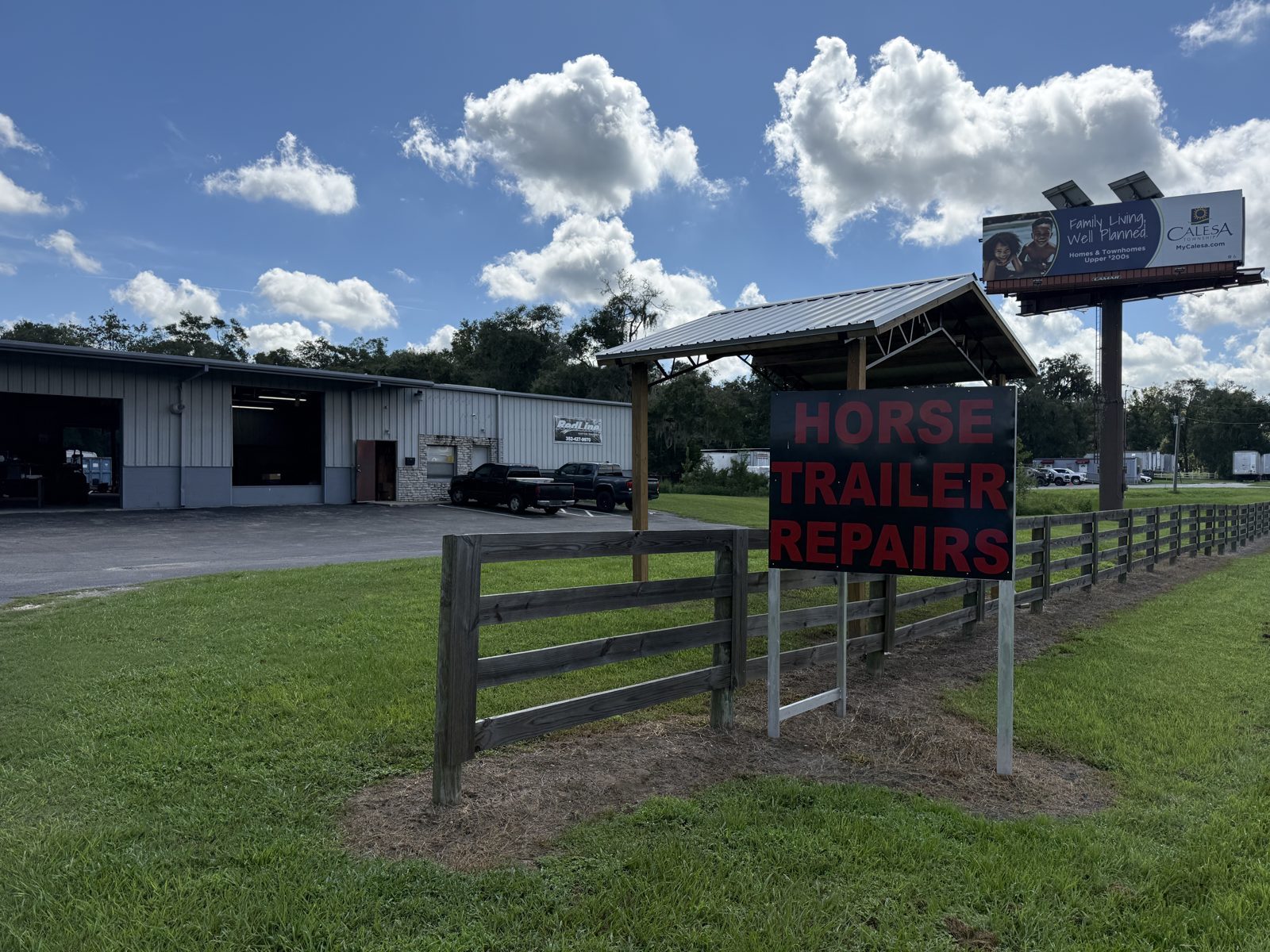
Marion County is home to more than 1,200 horse farms and something like 75,000 horses, which means a lot of trailers pulling out of a lot of driveways every week of the year. Our shop sits on US-27 with a “Horse Trailer Repairs” sign facing the road, so we see what goes wrong. The short version: the trailers that come in with real damage almost never failed suddenly. A floor went soft over a couple of years. A breakaway battery died in a tack room. A ramp spring rusted through where nobody could see it. All of it was findable, and most of it was findable in twenty minutes with a flashlight.
Work the year in four passes. Fall (October–November): the pre-season shakedown — brakes, breakaway battery, bearings, tire date codes, lights, every latch. Every haul, all winter: the five-minute walk-around. Spring (April–May): mats out, floor and frame inspected, the one check that decides whether the trailer is safe. Summer (June–September): the storm check — a trailer that can leave in an hour when a hurricane cone lands on Ocala. Bearings once a year or roughly every 10,000 miles, tires replaced at five to six years regardless of tread, and the floor looked at with the mats out, not through them.
We repair every make of horse trailer, from a two-horse bumper pull to a four-horse living-quarters gooseneck, and we build aluminum trailers, so we know what these things look like at both ends of their lives. Everything below is organized by season because that’s how Ocala actually uses a horse trailer: hard from December to April, then heat and storms until it cools off again.
The Ocala horse trailer maintenance calendar
| Season | The job | Why it’s timed this way |
|---|---|---|
| Fall (Oct–Nov) | Full shakedown: brake controller and magnets, breakaway battery, bearing inspection, tire date codes and pressure, lights and 7-way plug, ramp springs, every latch and hinge. | Show season starts in December. Fix it now, in the driveway, not at the WEC gate at 5 a.m. |
| Every haul (Dec–Apr) | Five-minute walk-around: hitch and safety chains, breakaway cable, lights, tires, doors and dividers latched, floor glanced with a light. | The trailer is working three or four days a week. Small problems become roadside problems fast. |
| Spring (Apr–May) | Mats out. Floor, cross-members and frame inspected, washed, and dried. Roof seams and window seals checked. Wiring cleaned. | A season of urine and manure sat on that floor. This is the check that finds rot and corrosion before a hoof does. |
| Summer (Jun–Sep) | Storm readiness: tires aired, jack working, battery charged, coupler greased, trailer parked hitch-accessible. Monthly if it’s sitting. | Hurricane season. A trailer that hasn’t moved since May has to be able to leave in an hour. |
| Once a year | Bearings repacked with new seals, brake shoes and drums measured, brake fluid flushed if hydraulic, U-bolts and hangers torqued. | Nothing on this line fails loudly. It fails quietly and then all at once. |
| Every 5–6 years | Replace the tires regardless of tread. | Trailer tires age out before they wear out, and Florida sun speeds it up. |
Print that and tape it inside the tack room door. Then the details, by season.
Fall: the pre-season shakedown
This post goes up in late October for a reason. The HITS circuit, the World Equestrian Center’s winter series and the OBS sales all land between December and April, and that’s when the county’s trailers work hardest. October and November are the window to find problems while you still have time to fix them. Put the trailer on level ground, get a flashlight, and work front to back.
- Test the brakes on a quiet road, not on the way to a show. Almost every horse trailer runs electric brakes. Hitch up, set the controller's manual override and creep forward — you should feel the trailer drag the truck. If you don't, it's the controller setting, the 7-way plug, a broken magnet wire or worn shoes, in that order of likelihood.
- Pull the breakaway pin and check that the brakes lock. Then put the pin back and check the battery. That little battery in its box on the tongue is what stops the trailer if it ever comes off the truck, and we find dead ones constantly. A charger with a maintainer lead solves it.
- Pull a dust cap and look at the grease. Tan or amber is fine. Gray, milky or runny means water in the bearing. Jack the wheel, spin it and listen; grab it at 12 and 6 o'clock and rock it. Roughness or play means the bearings come out. Yearly is the usual interval, or roughly every 10,000 miles, and a trailer that sat through a wet summer is not exempt.
- Read the tire date codes. The last four digits of the DOT stamp on the sidewall are the week and year the tire was made. At five to six years, replace them no matter how the tread looks. Inflate to the maximum cold pressure on the sidewall, not to what the truck runs.
- Torque the lug nuts, then recheck them after the first 50 miles. Aluminum wheels loosen more than steel.
- Run every light with someone behind the trailer. Running, brake, turn, both sides, plus the interior and loading lights. Clean the 7-way plug with contact cleaner and a dab of dielectric grease. Most "dead light" calls we get are a corroded pin or a bad ground.
- Work every latch, hinge and pin on the trailer. Divider pins, butt bars, door latches, the escape door, the ramp latches, the tack-room door. A latch that's stiff in October is a latch that fails in February with a horse leaning on it.
- Lift the ramp and look at the springs. Ramp springs live in the wettest corner of the trailer and rust from the inside. A broken spring turns a 40-pound ramp into a 150-pound one and drops it on whoever is under it.
Every haul: the five-minute walk-around
Show season means the trailer is hitched three or four times a week. The walk-around isn’t a maintenance job, it’s a habit, and it catches the failures that happen at 65 mph on I-75 or on the shoulder of SR-40 with horses on board.
- Coupler latched and pinned, chains crossed, breakaway cable on the truck. The cable goes to the tow vehicle's frame or hitch loop, not to the ball and not to the chains. On a gooseneck, confirm the coupler is locked on the ball and the safety chains are hooked.
- Lights, all of them, with the truck running. Someone stands behind; you hit the pedal and both turn signals. Thirty seconds.
- Tires by eye and by gauge. Sidewall bulges, cracking, anything low. A trailer tire that looks slightly soft is usually well under pressure, and under-inflation is the number one cause of trailer tire blowouts.
- Doors, dividers, butt bars latched before you load and after. Then walk the outside and push every door once more with the horses in.
- Glance at the floor with a light before the first horse steps on. Not a full inspection, just a look: a wet spot that shouldn't be there, a mat edge curled up, shavings that smell wrong.
- Feel each hub after the first long leg. Warm is normal. Too hot to hold your hand on means a bearing or a dragging brake, and that hub needs attention before the next haul.
Spring: mats out, floor inspected
This is the one check that actually determines whether a horse trailer is safe, and it’s the one most owners have never done, because it involves dragging out mats that weigh 80 to 100 pounds apiece. Do it anyway. Do it in April or May, after the season, when the trailer has a few weeks to sit.
Urine eats aluminum, and it eats it from under the mat where you can't see. Ammonia and the salts in horse urine corrode aluminum flooring, and the mats trap them against the metal for months. It shows up as white powder, then pitting, then a floor you can push a screwdriver through. Wood floors go the other way: the boards rot from the bottom, at the ends where they sit on the cross-members, and look fine from the top until a hoof finds the soft spot. Either way, the problem starts under the mats and the mats have to come out to find it.
- Pull every mat and wash the floor with water and a stiff brush. Then let it dry completely before the mats go back. On aluminum, look for white powder, pitting or any place the floor surface feels rough. Pay attention to the corners and the seam where floor meets wall.
- On a wood floor, probe every board with an awl or a screwdriver. Push hard at the ends of each plank and along the edges. Any give, any softness, any board that sounds different when you knock on it: replace it. Wood floors are replaced as boards, not as a whole floor, so catching one early is cheap.
- Get underneath with the flashlight. The cross-members that carry the floor are the structure. On steel trailers, look for scale and rust bleeding where the floor supports meet the frame rails. On aluminum, look for cracked welds at the cross-member ends and white corrosion at any spot where steel hardware touches aluminum.
- Check the roof seams and window seals from the inside on a bright day. Light coming through a seam means water coming through it in August. A leaking roof rots a wood floor from the top and keeps an aluminum floor wet all summer.
- Inspect the divider padding and the wall lining. Torn padding hides bent frames. Wall panels that have pulled away from the frame are a sign the structure behind them moved.
- Clean and re-hang the mats with the drain gaps open. Mats butted tight against the wall trap water. A small gap at the walls lets the floor breathe.
Soft boards, pitted aluminum and cracked cross-members are exactly what our floor and frame repair for horse trailers in Ocala is for. We’ll tell you straight whether it’s a couple of boards, a section of floor, or a frame that needs reinforcing, and we’ll say so if it’s fine.
The floors we replace almost always belong to trailers that were rinsed on the outside and never on the inside. A hose down the stall after every haul, mats lifted at the back end to drain, takes five minutes and adds years to an aluminum floor. We also see a lot of aluminum floors with steel screws driven into them by a previous repair: steel on aluminum in a wet environment is a corrosion cell, and it always ends in a hole. We use stainless hardware on anything we touch, for the same reason it's standard on every trailer we build.

Summer: heat, storms and the evacuation check
From June to September a lot of Ocala horse trailers sit. The ones that don’t sit are hauling to early-morning lessons and back before the afternoon storm. Either way, summer has two jobs: keep the heat from ruining what you fixed in the fall, and keep the trailer ready to leave.
- Air the tires monthly and keep them out of direct sun if you can. A trailer parked on grass with tires baking on the south side ages its rubber twice as fast. Tire covers are cheap. Sitting with low pressure flat-spots the tires and cracks the sidewalls.
- Keep the breakaway battery on a maintainer. Heat kills small batteries faster than cold. If the trailer has living quarters, the house battery too.
- Move the trailer a few feet every month. It keeps the bearings from sitting on one spot, keeps the brake shoes from bonding to the drums, and proves the jack and coupler still work.
- Wash the wiring and the plug. Daily summer thunderstorms plus humidity is the wettest environment a trailer sees, worse than winter hauling. Dielectric grease in the 7-way, and check the grounds.
- Look at the roof and vents after the first big storm. Water intrusion shows up in summer. Find it now, not when it's rotted a floor by spring.
- Run the hurricane drill once, in June. Hitch up, lights, brakes, load a horse, unload. Twenty minutes. When a cone lands on Marion County you'll be one of the people who can actually leave.
Summer is also when a good shop has time. The trailers that come in for bearings, brakes and wiring in July are on the road in days; the ones that come in the week before the HITS opener are in a line. If the fall list above turned up a job you’d rather not do yourself, our general trailer axle, bearing and brake service in Ocala is the same crew that does the horse trailer work, and the Florida boat trailer maintenance checklist covers the bearing and brake procedures in more depth if you want to do them on the driveway.
The parts that need a specialist
Most of this list is yours to do. A few things aren’t, either because they need a lift and a welder or because the consequences of getting them wrong involve a horse.
- Floor replacement and cross-member repair. Cutting out a section of aluminum floor and welding in new, or replacing rotted planks and the rusted supports under them, is structural work. It's the most common horse trailer job in our shop and the one where a bad fix is dangerous.
- Divider and butt-bar rebuilds. Bent dividers, sheared pins and stripped hinge mounts get rebuilt, not bent back. A divider that lets go with two horses in the trailer is a wreck in a box.
- Ramp spring and hinge replacement. Ramp springs are under load and snap. Have them replaced by someone with the tools to hold the ramp.
- Full re-wire. Chasing a ground through twenty-year-old wiring is a day; a new harness with heat-shrink connections and LEDs is done once. Our [horse trailer re-wire and LED lighting service](/repair/horse-trailer-repair/) is one of the most common jobs we do on trailers that came in for something else.
- Tires. Not us. We fix the trailer, not the rubber. For ST-rated tires and a free date-code read, we send people to [trailer tires in Ocala at Tire Express](https://www.tireexpressandservice.com/trailer-tires-ocala/).
Do it yourself, or bring it in?
Do it yourself…
- The every-haul walk-around, no exceptions
- Rinsing the stall floor after each haul, mats lifted to drain
- Tire pressure, date codes and lug torque
- Pulling mats in the spring and washing the floor
- Probing wood boards, checking the breakaway battery, cleaning the plug
- Greasing hinges, latches, the coupler and the jack
Bring it to the shop…
- Any softness in a floor or pitting in aluminum you can feel
- Rust or cracked welds at the cross-members or frame rails
- Brakes that don't grab on the manual override after you've checked the plug
- Milky grease, play in a wheel, or a hub that runs hot
- Bent dividers, broken ramp springs, latches that won't hold
- A ground fault you've spent more than an hour chasing
None of this takes special skill. It takes a calendar and the willingness to drag the mats out once a year. The trailers we see with real damage aren’t owned by people who couldn’t have done this. They’re owned by people who meant to.
Get the trailer looked at
Floor, frame, dividers, ramp, brakes, wiring — any make of horse trailer. We'll tell you what's fine, what's due, and what shouldn't haul a horse until it's fixed.
Horse trailer maintenance questions we get in Ocala
How often should I pull the mats and inspect a horse trailer floor?
At least once a year, with the mats fully out, and spring is the right time in Ocala because the floor just spent show season under urine and manure. Rinse the floor after every haul with the mats lifted at the back to drain, and do a full mats-out inspection any time you notice a wet spot, a smell that lingers, or a mat edge that has curled.
How long does an aluminum horse trailer floor last?
It depends almost entirely on whether it was washed. An aluminum floor that’s rinsed after hauls and dried with the mats out can outlast the trailer. One that sits under wet mats can pit through in a few seasons, because ammonia and the salts in urine corrode aluminum and the mats hold them against the metal. Steel screws driven into an aluminum floor also create corrosion that eats a hole around the fastener.
How do I know if my horse trailer’s wood floor is rotten?
Pull the mats and probe every board with an awl or screwdriver, pressing hard at the ends of each plank where it sits on the cross-members and along the edges by the walls. Any give, softness, or a dull sound when you knock on it means the board is rotting from underneath. Look at the boards from below too. Wood floors are replaced board by board, so one bad plank caught early is a cheap fix.
Does a horse trailer need brakes in Florida?
Florida requires brakes on any trailer with a gross weight of 3,000 pounds or more, which is every horse trailer with a horse in it. Nearly all horse trailers use electric brakes controlled from the truck, plus a breakaway system with its own battery that applies the brakes if the trailer separates. Test both before show season: the brakes on the controller’s manual override, and the breakaway by pulling the pin.
How often should horse trailer bearings be repacked?
The usual guidance is once a year or about every 10,000 miles, whichever comes first, with new seals each time. Check them in the fall before show season by pulling a dust cap and looking at the grease, then spinning and rocking the jacked-up wheel. Milky or gray grease, roughness, or play in the wheel means the bearings come out now, regardless of the calendar.
What should I check on a horse trailer that has been sitting all summer?
Tire pressure and date codes, the breakaway battery, the lights and 7-way plug, the coupler and jack, and whether the brakes have bonded to the drums from sitting. Then pull a dust cap and look at the grease, because bearings that sat through a humid Florida summer can have water in them. Move the trailer a few feet every month while it’s parked to prevent most of this.
← All posts